
What Is an AI Readiness Assessment and Why You Need One
Discover how an AI readiness assessment helps evaluate your organization's strategy, data, and governance for successful AI initiatives.

An AI readiness assessment is a scored evaluation of your organization across core pillars, strategy, data, infrastructure, governance, and people, that tells you exactly where you stand before you commit budget to AI. The deliverable is concrete: a diagnostic score, a list of prioritized gaps, and a recommended roadmap. Most take the form of a structured questionnaire or an interactive scoring tool, and you can complete a useful first pass in under an hour.
TL;DR:
- Ensuring a high score in strategy, data foundations, infrastructure, governance, and people is crucial, as neglecting any pillar risks AI project failure within six months.
- Conducting regular assessments, ideally quarterly, helps leadership track progress and prevent outdated scores from misleading project planning.
- Focus on clear use cases with measurable outcomes, strong data governance, scalable infrastructure, and trained staff to convert a readiness score into a successful AI system.
- Using industry benchmarks like maturity bands motivates improvement and highlights specific weak points, rather than relying on raw or single-time scores.
- When internal skills or compliance requirements are lacking, partnering with specialists accelerates the transition from assessment to a stable, production-ready AI platform.
Table of Contents
- What an AI Readiness Assessment Actually Measures
- How Do You Run an AI Readiness Assessment?
- A 15-Question Readiness Checklist You Can Copy
- From Score to Delivery: A 30/60/90 Plan
- Case Studies: How Readiness Assessments Play Out by Industry
- How Do Maturity Models Benchmark AI Readiness?
- Which Tools Help You Assess AI Readiness?
- Treat Readiness as a KPI, Not a One-Time Report Card
- Turn Your Score Into a Working AI System
- Sources
What an AI Readiness Assessment Actually Measures
Every credible assessment breaks down into five pillars, and skipping any one of them is how AI pilots quietly die six months in.
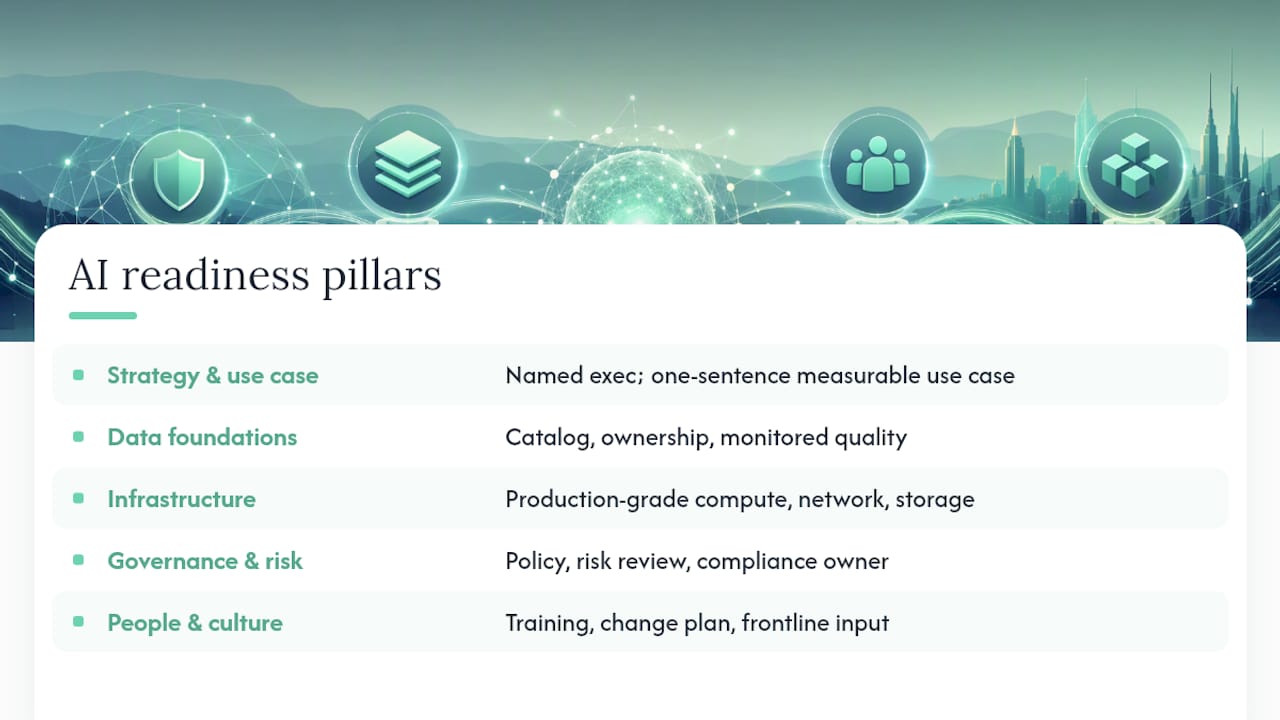
Strategy and use-case clarity comes first. Microsoft's own AI Readiness Assessment evaluates business strategy alongside governance, data, infrastructure, and model management across roughly 45 multiple-choice questions, then returns personalized guidance. The evidence to look for here is simple: does a named executive own the AI agenda, and can someone articulate a use case in one sentence with a measurable outcome attached? Optimizely's use-case discovery work found that the highest-impact AI projects sit inside existing slow or manual workflows, not in speculative new products, and that clear problem statements separate pilots that ship from ones that stall.
Data foundations need a real answer to "where does our data live and who can access it." Look for a data catalog, defined ownership, and at least one system where data quality is actively monitored rather than assumed.
Infrastructure readiness shows up in whether your network, storage, and compute can support a model in production, not just a demo. Underestimating ongoing compute costs is one of the most common traps teams fall into once a pilot needs to scale.
Governance and risk requires a documented policy for model use, a risk review process, and someone accountable for compliance. The World Economic Forum's reporting on adoption obstacles points to data fragmentation and governance gaps as two of the most persistent blockers to scaling AI past the pilot stage.
People and culture is the pillar most leaders underrate. Evidence here includes training programs, a change-management plan, and whether frontline staff have any say in how AI tools get rolled out. Weak scores in this pillar are the single most common reason technically sound pilots never get adopted.
How Do You Run an AI Readiness Assessment?
Running the assessment well matters as much as the questions themselves. Get the process wrong and you get a score that looks precise but means nothing.
- Assemble the right room. You need the CEO or a C-suite sponsor, your CIO or CDO, function leaders whose teams will actually use the AI, and whoever owns your data infrastructure. Leave out the data owner and your infrastructure score will be a guess dressed up as a number.
- Pick a format that matches your stakes. A facilitated workshop surfaces disagreement in the room, which is valuable; a self-assessment questionnaire is faster but risks siloed, overly optimistic answers. Budget 5 to 15 minutes per leader for a quick pulse check, up to 45 minutes each for a full diagnostic.
- Score consistently. Use a simple 0 to 2 scale per question (0 for no evidence, 1 for partial, 2 for documented and working), or roll answers into a banded 0 to 100 score. Cisco's AI Readiness Index groups organizations into bands like Pacesetter, Chaser, and Follower, language that gives leadership an immediate sense of relative position.
- Set a cadence. Reassess quarterly while you have active AI initiatives running, and always before greenlighting a major new one. Readiness shifts fast once budget starts moving, and a score from eight months ago is close to useless.
The most common trap is vague use cases dressed up as strategy. "We want to use AI for customer service" is not a use case; "reduce average ticket resolution time by cutting the research step" is. The second trap is letting each department answer in isolation, which produces a governance score from IT and a completely different one from marketing, with no way to reconcile them.
Pro Tip: Run the assessment twice, once as a facilitated group session and once as individual self-assessments, then compare the gaps between the two. Large gaps between what leaders say privately and what they agree to publicly are often more informative than the score itself.
A 15-Question Readiness Checklist You Can Copy
A workable checklist stays short enough to finish in one sitting but covers every pillar that actually predicts whether AI initiatives succeed. Elevates.AI's model of 15 questions across five dimensions is a solid structure to build from: three questions per pillar, each scored 0 to 2.
- Can you state your top AI use case and its business outcome in one sentence?
- Does a named executive sponsor own AI adoption?
- Have you scoped at least one pilot with a measurable success metric?
- Do you have a data catalog covering your core business systems?
- Is there a defined process for data ownership and quality checks?
- Can relevant teams access clean data without a manual export process?
- Does your infrastructure support running a model in production, not just a proof of concept?
- Have you budgeted for ongoing compute costs, not just build costs?
- Is there a monitoring system to flag when a model's performance degrades?
- Do you have a documented AI governance or usage policy?
- Is there a risk review step before any AI tool goes live?
- Is someone accountable for AI compliance and data privacy?
- Have staff who'll use AI tools received any structured training?
- Is there a change-management plan for teams affected by new AI workflows?
- Do frontline employees have a channel to flag problems with AI tools?
Add up your score out of 30. 0 to 12 means foundational gaps across multiple pillars; focus entirely on strategy clarity and data cleanup before touching a build. 13 to 21 means you have real assets but uneven coverage; pick your two weakest pillars and fix those first. 22 to 30 means you're ready to scope a production build now. Whatever band you land in, take your three lowest-scoring questions and turn them into your first 90-day priority list.
From Score to Delivery: A 30/60/90 Plan
A number on a page changes nothing until someone owns turning it into work. Take your single lowest-scoring pillar and build a 30-day quick win around it: something like standing up a data catalog for one business unit or drafting a one-page AI usage policy. Days 31 through 60 go toward stabilization, testing that quick win against real workflows and assigning a permanent owner. Days 61 through 90 are for scaling the fix and scoping your first production pilot against a metric you can actually measure, like ticket resolution time or manual hours saved.
Each phase needs an owner, a success metric, and a named artifact, a data catalog, a monitoring dashboard, a governance document, that proves the work happened.
| Decision factor | Build in-house | Bring in a partner |
|---|---|---|
| Internal AI/ML skills | Present and available | Missing or stretched thin |
| Timeline pressure | Flexible | Tight, board-driven deadline |
| Compliance requirements | Standard | Regulated data, high security bar |
| Production-grade build needed | Not yet, still exploring | Yes, needs to ship and scale |
Logicbranch has run this exact diagnosis-to-delivery path for enterprise and SMB clients moving from a readiness score to a working AI-native platform, prioritizing secure, compliant builds over speed for its own sake.
Case Studies: How Readiness Assessments Play Out by Industry
A financial services firm assessing readiness typically scores high on governance, thanks to existing regulatory infrastructure, but low on use-case clarity, because compliance teams are cautious about scoping anything concrete. The fix tends to be narrow: one contained use case, like flagging anomalous transactions, rather than a broad "AI for fraud" mandate.

A healthcare provider usually inverts that pattern. Clinical staff can name urgent use cases immediately, appointment no-show prediction, documentation assistance, but data foundations lag because patient data sits fragmented across legacy systems with strict access controls. The World Economic Forum's coverage of adoption obstacles specifically calls out data fragmentation as a top blocker, and healthcare is where it shows up hardest.
Manufacturing organizations often score well on infrastructure, since industrial IoT and sensor networks are already in place, but poorly on people and culture. Floor staff who were never consulted on a predictive-maintenance rollout tend to distrust it, regardless of how accurate the model is.
Retail and e-commerce businesses cluster around strong use-case clarity (personalization and demand forecasting are obvious wins) paired with shaky governance, since fast-moving marketing teams deploy AI tools before anyone reviews data privacy implications. None of these patterns are universal, but they show why the same five-pillar framework surfaces different weak points depending on what your industry already had to build for other reasons.
How Do Maturity Models Benchmark AI Readiness?
Raw scores mean little without something to compare them against, which is why most serious frameworks group results into maturity bands rather than reporting a bare number. Cisco's readiness index sorts organizations into tiers including Pacesetters and Chasers, based on scored performance across six dimensions: strategy, infrastructure, data, governance, talent, and culture. The framing matters because it tells leadership where they stand relative to peers, not just whether they passed an internal bar.
Band language works because it's motivating in a way a raw percentage isn't. Being told you're a "Chaser" prompts a different conversation than being told you scored 61 out of 100, even if the underlying data is identical. That's a deliberate design choice in how these tools present results, and it's worth borrowing even if you build your own internal scoring rubric instead of using a vendor tool.
The more important point buried in most maturity models is that readiness is not a one-time certification. Cisco frames it explicitly as a journey rather than a destination, and that framing should shape how you treat your own score. A Pacesetter result this quarter does not guarantee the same result next quarter if your data infrastructure stalls or your governance policy goes stale. Treat any benchmark, whether it's a named vendor tier or a rubric you built internally, as a snapshot you'll retake, not a badge you earn once. The organizations that actually benefit from these models are the ones that reassess on a fixed cadence and track whether their band is improving, not the ones that run the assessment once and file the result away.
Which Tools Help You Assess AI Readiness?
Vendor assessment tools give you a fast, structured starting point without building a framework from scratch. Microsoft's assessment tool walks through roughly 45 questions across seven pillars and returns personalized recommendations rather than a static score, which makes it genuinely useful for a first pass. Cisco's index adds the maturity-band structure described above, useful if you want a benchmark against industry peers rather than just an internal number. Elevates.AI's shorter 15-question checklist works well as a lightweight pulse check between full assessments, especially for teams that don't have the appetite for a 45-question deep dive every quarter.
Beyond structured questionnaires, some organizations track readiness through project management tools repurposed as scorecards, spreadsheets with weighted pillar scores, or dashboards built into whatever business intelligence platform they already use. None of these substitute for the underlying work of actually building a data catalog or writing a governance policy, but they make the score visible and trackable over time, which matters more than the tool itself. The right tool is the one your leadership team will actually revisit next quarter, not the one with the most sophisticated scoring algorithm.
For teams that want their assessment to feed directly into a build rather than sit in a report, working with a partner that handles both the diagnostic and the resulting AI-native software cuts out the translation gap between "here's your score" and "here's what we're actually building."
Treat Readiness as a KPI, Not a One-Time Report Card
Most organizations run an AI readiness assessment once, file the results, and never look at the score again. That's the biggest mistake I see in how leadership teams treat this process. Readiness shifts fast once real budget and real projects are in motion, and a score from two quarters ago tells you almost nothing about where you stand today.
Elevate it to an operational KPI. Give it a named owner, a quarterly review slot on the executive calendar, and the same seriousness you'd give a revenue target. Logicbranch has watched this pattern play out across client engagements: the organizations that treat readiness as ongoing infrastructure, not a report, are the ones whose AI pilots actually reach production.
— Josh
Turn Your Score Into a Working AI System
Getting a readiness score is the easy part. Turning it into a secure, production-grade AI system that survives contact with real users and real data is where most internal teams stall, either because the skills aren't in-house or the timeline doesn't allow for a slow build-and-learn cycle.
Logicbranch runs both halves of this process: a practical readiness assessment mapped to your specific pillars, followed by a 90-day implementation sprint that turns your top-priority gap into a working AI-native platform, whether that's a custom SaaS build, an AI agent, or a document workflow system. It makes the most sense to bring in a partner like Logicbranch when you're missing in-house AI or ML skills, working against a board-driven deadline, or building something with real compliance stakes, regulated data, security audits, production uptime, where a proof of concept isn't good enough. If your last assessment surfaced a gap you don't have the internal bandwidth to close, book a discovery call with Logicbranch and scope what a 90-day build against that gap would actually look like.
Sources
- AI Readiness Assessment — Microsoft Assessments
- Elevates
- Cisco AI Readiness Assessment
- AI readiness — World Economic Forum
Recommended

API-First Design: What It Is and How to Apply It
API-first design means agreeing the API contract before building anything. See how it works, when it beats code-first, and how Australian businesses can use it.

Tokenization vs Encryption: How to Choose for Your Data
Tokenization and encryption protect data in different ways. Learn how each works, how they compare with masking and hashing, and which fits your Australian business.