
Australian Privacy Principles: 13 Rules and What Tech Teams Must Do
Engineering-focused explainer of the 13 Australian Privacy Principles: who must comply, common breaches, and practical steps SaaS and AI teams can implement.

The Australian Privacy Principles are 13 legally binding rules set out in Schedule 1 of the Privacy Act 1988 that govern how organisations and government agencies collect, use, store, and disclose personal information. They apply to most federal government agencies and to private businesses with annual turnover above the threshold set by the Attorney-General's Department, along with specific smaller entities that handle health data or tax file numbers. If your business meets that test, you need a compliant privacy policy and documented "reasonable steps" for every principle that applies to your operations.
TL;DR:
- Most Australian businesses handling health data, tax file numbers, or with over $3 million annual turnover must comply with the APPs regardless of size.
- APP 5 requires immediate notification to individuals and the OAIC within 30 days if a breach is likely to cause serious harm.
- Cross-border data disclosures necessitate documented legal bases, with stricter obligations if sending data to countries with similar data protection laws.
- Implementing privacy by design from the start reduces costs, increases compliance confidence, and helps meet reasonable steps for security under APP 11.
- A designated privacy lead and regular vendor reviews are essential to maintaining ongoing compliance with evolving privacy and breach response obligations.
Table of Contents
- What Are the 13 Australian Privacy Principles?
- Who Has to Comply With the Australian Privacy Principles?
- How Do the Detailed APPs Apply to Your Business?
- What Does an APP Compliance Plan Actually Look Like?
- What Happens When a Business Breaches the APPs?
- What Do the Less Talked-About APPs Actually Require?
- What Do Typical APP Breaches Actually Look Like?
- Who Inside Your Organisation Owns APP Compliance?
- What Counts as Personal Information Under the APPs?
- How Did the Australian Privacy Principles Come to Exist?
- How Do the APPs Compare to the GDPR and Other Frameworks?
- Building Privacy Into the Software, Not Bolting It On Afterward
- How Logicbranch Helps You Build APP-Compliant Systems
- Sources
- FAQ
What Are the 13 Australian Privacy Principles?
Each principle covers a distinct stage of handling personal information, from the moment you collect it to the day someone asks you to correct it. The Federal Register of Legislation groups them into five parts, but for day-to-day compliance work, it helps to see all 13 laid out plainly.
- APP 1: Open and transparent management of personal information. You need a clear, current privacy policy anyone can find and read.
- APP 2: Anonymity and pseudonymity. People should be able to deal with you without identifying themselves, where practical.
- APP 3: Collection of solicited personal information. You can only collect what's reasonably necessary for your functions.
- APP 4: Dealing with unsolicited personal information. If information arrives unasked, you must assess it and destroy or de-identify it if you couldn't have collected it lawfully.
- APP 5: Notification of the collection of personal information. Tell people what you're collecting, why, and what happens to it.
- APP 6: Use or disclosure of personal information. Use data only for the purpose you collected it for, unless an exception applies.
- APP 7: Direct marketing. Strict limits apply to using personal information for marketing without consent or a reasonable expectation.
- APP 8: Cross-border disclosure of personal information. Sending data overseas carries extra obligations, including accountability for what happens to it there.
- APP 9: Adoption, use, or disclosure of government-related identifiers. You generally can't adopt a Medicare number or similar as your own customer ID.
- APP 10: Quality of personal information. Keep the data accurate, complete, and up to date.
- APP 11: Security of personal information. Protect it against misuse, loss, and unauthorized access, and destroy it when it's no longer needed.
- APP 12: Access to personal information. Individuals can generally ask to see what you hold on them.
- APP 13: Correction of personal information. If it's wrong, you generally have to fix it.
The OAIC's "Read the Australian Privacy Principles" page carries the full text of each principle along with the regulator's own explanatory notes, which is worth bookmarking before you draft policy language.
Who Has to Comply With the Australian Privacy Principles?
The Privacy Act uses the term "APP entity" to describe anyone bound by these rules, and the Attorney-General's Department sets out the coverage test plainly: most Australian and Norfolk Island government agencies are covered automatically, and private sector organisations join the list once they meet the turnover and other criteria outlined by the Department.
Turnover under that threshold doesn't automatically exempt you, though. Health service providers, businesses that trade in personal information, credit reporting bodies, and any entity handling tax file numbers must comply regardless of size. Contractors delivering Commonwealth services under contract are typically caught too, whatever they turn over annually.
A quick self-check: if you earn over $3 million a year, hold any health records, buy or sell personal data, or handle TFNs, you're an APP entity. If none of those apply, check your specific industry rules before assuming you're exempt.
How Do the Detailed APPs Apply to Your Business?
The Privacy Act 1988's Schedule 1 organizes the 13 principles into five parts, each mapping to a different stage of the information lifecycle. Understanding the grouping helps you see which team in your organisation owns which obligation.
- Consideration of personal information privacy (APP 1 to 2). APP 1 requires a clearly written, publicly available privacy policy that explains what you collect and why, and APP 2 requires you to offer anonymous or pseudonymous options wherever that's practical. A retail loyalty program that lets customers earn points without providing a name, for instance, satisfies APP 2 in a way a registration-only scheme doesn't.
- Collection of personal information (APP 3 to 5). APP 3 limits collection to what's reasonably necessary for your business functions, so a food delivery app collecting a customer's blood type would fail this test outright. APP 4 covers information that shows up uninvited, such as a resume emailed to the wrong department, which you generally must assess and then destroy or de-identify. APP 5 requires you to notify people at the point of collection, typically through a collection statement on the form itself.
- Dealing with personal information (APP 6 to 9). APP 6 restricts use and disclosure to the original purpose unless an exception applies, and APP 7 puts firm limits on direct marketing without consent. APP 8 is the one that catches technology teams off guard: any disclosure of personal information to an overseas recipient, including a cloud vendor's offshore server, makes your business accountable for how that recipient handles the data. Amendments to the Privacy Act have since clarified how the Minister can prescribe countries or binding schemes that meet substantially similar protections to Australia's, which gives businesses a narrower, better documented path for relying on an overseas data-handling arrangement. APP 9 stops you from adopting a government identifier, like a driver's license number, as your own internal customer reference.
- Integrity of personal information (APP 10 to 11). APP 10 requires reasonable steps to keep information accurate and current, which matters most for businesses making decisions based on stored data, such as credit assessments. APP 11 is the security principle, and it's the one regulators return to most often after a breach: you must protect information from misuse, interference, loss, and unauthorized access, and destroy or de-identify it once it's no longer needed for any purpose the Act allows.
- Access to, and correction of, personal information (APP 12 to 13). People can generally request access to what you hold on them and ask you to correct inaccuracies, with limited exceptions for law enforcement or legal privilege.
The OAIC's APP guidelines describe the whole framework as principles-based and technology-neutral, which means there's no fixed checklist for APP 11 security. A small retailer's reasonable steps look different from a hospital network's, and that flexibility is either a relief or a headache depending on how comfortable your team is documenting judgment calls.
What Does an APP Compliance Plan Actually Look Like?
Turning 13 principles into daily practice starts with governance, not technology. Someone in your organisation needs to own privacy decisions, and your privacy policy under APP 1.3 and 1.4 needs to stay current, not sit untouched since the year you launched.
- Appoint a privacy lead and record decisions. Someone accountable for reviewing new projects against the APPs, with a written log of what was decided and why.
- Build privacy by design into your architecture. Minimize the data you collect, set retention periods before you launch rather than after a regulator asks, and design systems so deleting a record actually deletes it everywhere.
- Run privacy impact assessments on higher-risk projects. Any system handling health data, biometric information, or large-scale customer profiles warrants a documented risk assessment before go-live, not after.
- Document your cross-border reliance path. For APP 8, decide whether you're relying on consent, an enforceable contract, or a prescribed country or binding scheme, and put that decision in writing before data leaves Australia.
- Map security controls to APP 11 explicitly. Encryption at rest and in transit, role-based access control, patch management schedules, and audit logging should each tie back to a specific APP 11 obligation in your documentation.
- Vet vendors on a fixed schedule. Contract clauses covering data handling, breach notification timing, and audit rights should be reviewed at least annually, not just at signing.
Pro Tip: Treat "reasonable steps" as a moving target tied to sensitivity, not a fixed technical bar. A basic access-control policy might satisfy APP 11 for a stationery supplier, but a business holding health records needs encryption, strict vendor contracts, and regular penetration testing to meet the same standard.
A security and trust framework built around documented risk management gives you a model for how this kind of accountability gets written down and reviewed over time.
What Happens When a Business Breaches the APPs?
The OAIC's enforcement toolkit ranges from quiet correction to public penalty. It can open an investigation, accept an enforceable undertaking, conduct an assessment of an entity's privacy practices, or, for serious or repeated interference with privacy, pursue civil penalties through the courts.
The Notifiable Data Breach scheme sits alongside that enforcement power and applies whenever a breach is likely to result in serious harm to the people affected.
- Identify the breach and contain it immediately, cutting off further access where possible.
- Assess within 30 days whether the breach meets the "likely to result in serious harm" threshold.
- If it does, notify affected individuals and the OAIC as soon as practicable, describing what happened and what you're doing about it.
- Remediate the underlying cause and keep a written record of every step taken, since the OAIC can request that record later.
- Review vendor and system controls that contributed to the breach so the same gap doesn't reopen.
Speed matters here more than most compliance obligations. A business that notifies late, or not at all, faces a materially different regulatory conversation than one that reports promptly and shows its working.
What Do the Less Talked-About APPs Actually Require?
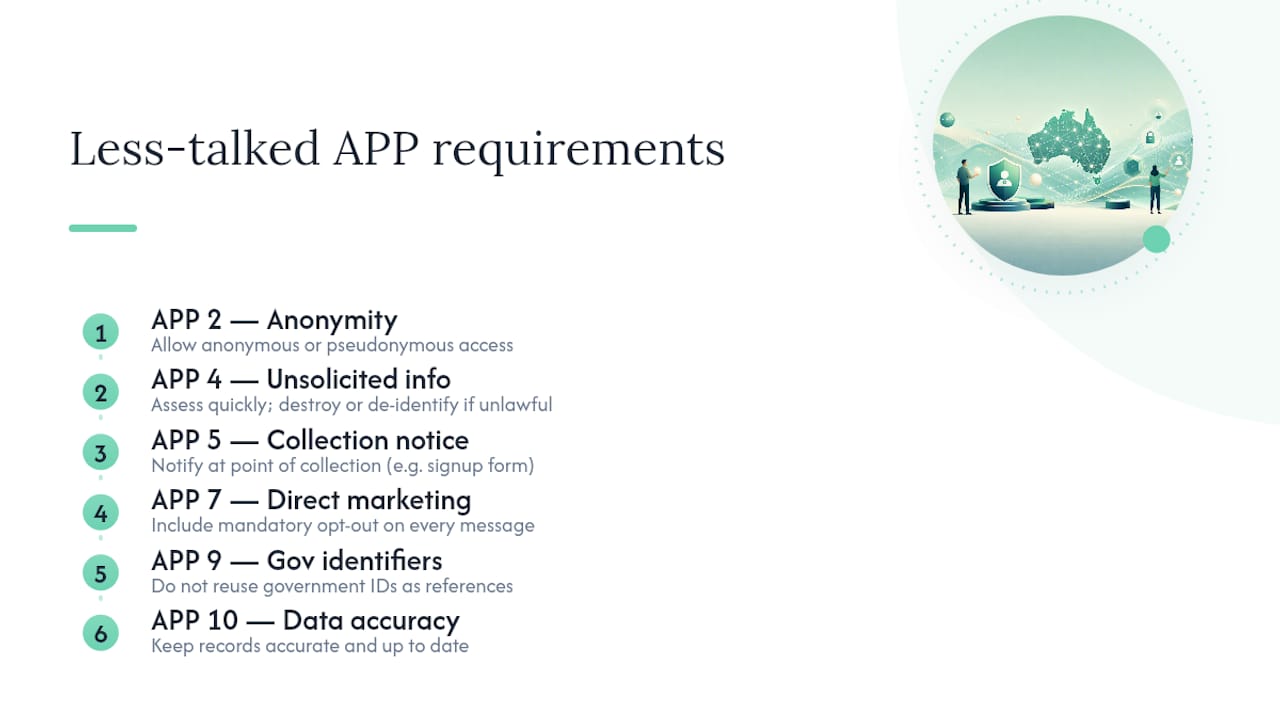
APP 2, 4, 5, 7, 9, and 10 rarely make headlines, but they trip up businesses just as often as the security and cross-border rules do. APP 2 requires you to let people interact anonymously or under a pseudonym wherever that's practical, which matters for anything from a customer service chatbot to a public feedback form. If your system forces full identification for no real functional reason, you've likely fallen short of this principle.
APP 4 covers information you never asked for, like a job application sent to the wrong inbox. The obligation is to assess it quickly: if you couldn't have lawfully collected it under APP 3, you generally need to destroy or de-identify it rather than filing it away "just in case."
APP 5 requires a notification at the point of collection, not buried three pages into a privacy policy nobody reads. A collection statement on a signup form, stating what you're gathering and why, usually covers this.
APP 7 puts firm limits on direct marketing, including a mandatory opt-out on every marketing communication. This is where a lot of small businesses first encounter the Act, usually after a complaint about an email list they bought rather than built.
APP 9 stops businesses from repurposing a government identifier, like a Medicare or driver's license number, as an internal customer reference. It's a narrow rule but an easy one to breach by accident when a system defaults to using whatever ID number is on file.
APP 10 requires your data to stay accurate and current, particularly relevant for any business making decisions, like credit or eligibility calls, based on stored records.
What Do Typical APP Breaches Actually Look Like?
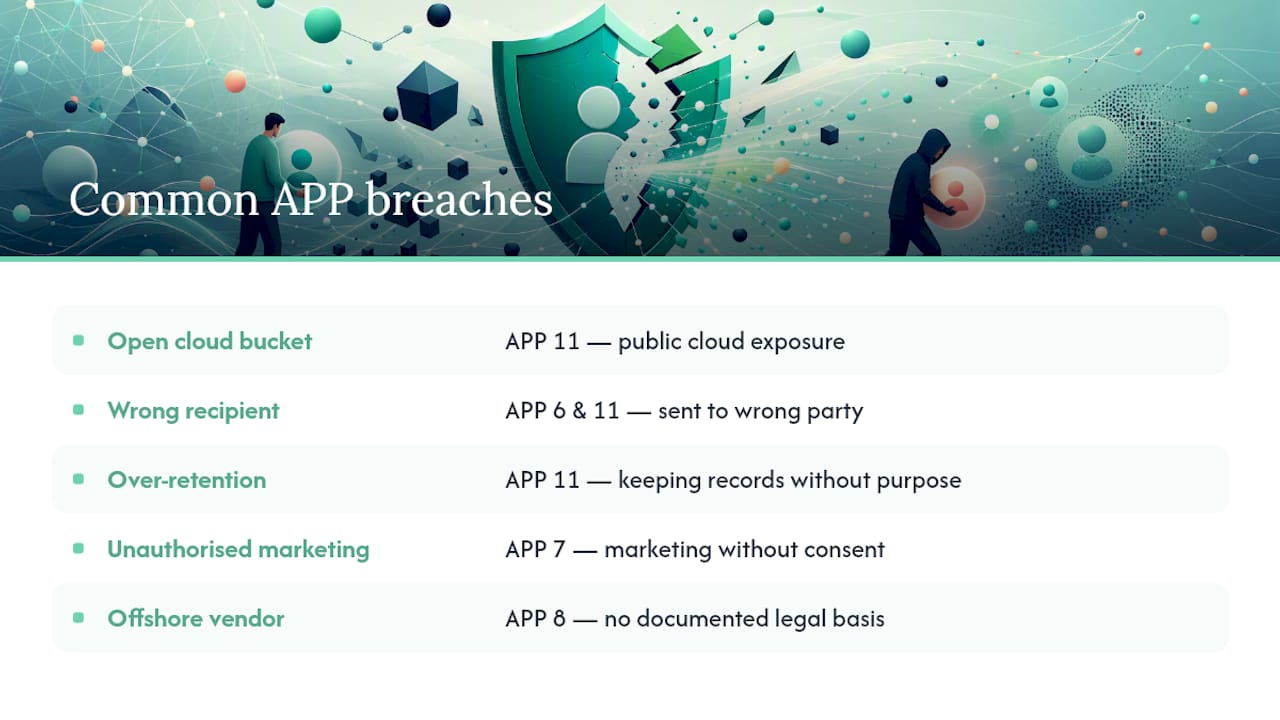
Most breaches trace back to ordinary business mistakes rather than sophisticated attacks. A misconfigured cloud storage bucket left publicly accessible is one of the most common patterns, exposing customer records to anyone who stumbles across the link. It's an APP 11 failure, but it usually starts with a rushed deployment rather than malicious intent.
Sending personal information to the wrong recipient is another recurring one, whether that's a spreadsheet of customer details CC'd to the wrong email thread or a marketing list shared with a vendor who was never authorized to receive it. That's typically both an APP 6 and APP 11 problem at once.
Retaining data far longer than any business purpose justifies is a quieter but widespread breach. A business that still holds ten years of customer records with no active use for them has a weak APP 11 position the moment any of it leaks, because there was never a valid reason to keep it that long.
Using customer data for marketing without proper consent, particularly after acquiring a mailing list through a business sale or partnership, breaches APP 7 more often than businesses realize. And relying on an offshore vendor without documenting the legal basis under APP 8 is a compliance gap that often stays invisible until a breach forces the question.
Who Inside Your Organisation Owns APP Compliance?
Privacy compliance works best when one person is clearly accountable, even in a small business. Many organisations formalize this with a Privacy Officer role, someone responsible for maintaining the privacy policy, handling access and correction requests under APP 12 and 13, and coordinating the response if a breach occurs.
In larger organisations, that role often sits within legal or compliance, with technical implementation owned by IT or engineering leads who translate APP 11's security requirements into actual system controls. The split matters: a Privacy Officer can write a policy, but only engineering can decide whether encryption is actually configured correctly on a database.
Individual employees carry responsibility too, particularly around APP 6 and APP 7. Someone handling a customer complaint who forwards personal details to an unrelated department without a clear purpose has created a compliance problem regardless of what the official policy says. Training staff on what counts as a permitted use, and what doesn't, closes a gap that no policy document alone can fix.
What Counts as Personal Information Under the APPs?
Personal information under the Act covers any information or opinion about an identified individual, or someone who is reasonably identifiable, whether it's true or not. That definition is broader than most businesses assume.
A name and email address are the obvious examples, but the definition extends to IP addresses tied to a specific user session, location data captured through an app, purchase history linked to a loyalty account, and even an employer's written opinion about a staff member's performance. Photographs, voice recordings, and biometric data all qualify too, and health information carries additional protections beyond the standard APPs.
What doesn't count is genuinely de-identified or aggregated data, where no reasonable process could re-link it to a specific person. The line between de-identified and merely anonymized-sounding data is narrower than many businesses think, particularly with small datasets where a handful of attributes can re-identify someone even without a name attached.
How Did the Australian Privacy Principles Come to Exist?
The Privacy Act 1988 originally split its obligations between the Information Privacy Principles for federal agencies and the National Privacy Principles for the private sector, a two-tier system that created confusion about which set applied where. Reforms consolidated both into the single set of 13 Australian Privacy Principles that took effect in 2014, giving government and business one shared standard for the first time.
Since then, amendments have kept pace with how data actually moves. Cross-border disclosure rules under APP 8 have been clarified to address cloud computing and offshore vendor arrangements far more common today than they were in 2014, and the Notifiable Data Breach scheme was added afterward to close a gap where serious breaches could go unreported. The direction of travel has been toward more explicit obligations and stronger enforcement, not fewer.
How Do the APPs Compare to the GDPR and Other Frameworks?
The APPs and the European Union's GDPR share the same underlying goal, control over personal information, but they diverge in a few practical ways that matter for any business handling data across both regimes.
Consent operates differently. The GDPR generally requires an affirmative, freely given consent as a primary lawful basis for processing, while the APPs rely more heavily on reasonable expectation and notification at the point of collection. Penalties differ sharply too: the GDPR permits fines up to a percentage of global turnover, a scale the current Australian civil penalty framework doesn't mirror directly. Extraterritorial reach also works differently, since the GDPR applies to any business processing EU residents' data regardless of location, while the Privacy Act's reach depends more on an entity's Australian connection and the $3 million turnover test.
For a business operating in both markets, the practical answer is to build to the stricter standard where the two frameworks diverge, since a system compliant with GDPR consent requirements will generally satisfy APP 5 notification obligations without extra work.
Building Privacy Into the Software, Not Bolting It On Afterward
Most privacy failures we see trace back to architecture decisions made months before anyone thought about compliance. Retrofitting access controls or data retention rules onto a system that was never designed for them is slower and far less reliable than building those constraints into the requirements and design stages from the start. That's the practical case for privacy by design: it's not a compliance nicety, it's a structural choice that determines whether "reasonable steps" under the APPs are demonstrable later.
— Josh
How Logicbranch Helps You Build APP-Compliant Systems
Retrofitting privacy controls onto a system that was never designed for them is expensive and rarely convincing to a regulator after the fact. Some providers build privacy-by-design engineering, secure integrations, and cross-border data handling into the architecture from day one, not as a patch applied after launch.
For businesses building AI-native platforms, automation tools, or custom SaaS products, that means data minimization, retention rules, and access controls get designed into the system before a single line of production code ships. Our teams also support vendor contract reviews and documentation for cross-border disclosures under APP 8, so the "reasonable steps" your Privacy Officer needs to demonstrate are already built into how the software works. If your organisation is planning a new platform or overhauling an existing one, talk to Logicbranch about your project and get privacy engineered in from the start rather than added on afterward.
This article is general information, not a substitute for advice from a qualified lawyer. Consult a qualified legal professional about your own circumstances before acting on anything here.
Sources
FAQ
What Are the 13 Australian Privacy Principles?
They are the 13 legally binding rules in Schedule 1 of the Privacy Act 1988 covering how organisations manage, collect, use, disclose, and secure personal information, from open transparency (APP 1) through to correction rights (APP 13).
What Are the 13 Principles of the Privacy Act?
They cover transparency, anonymity, collection, unsolicited information, notification, use and disclosure, direct marketing, cross-border disclosure, government identifiers, data quality, security, access, and correction, grouped into five parts under Schedule 1.
Where Are the Australian Privacy Principles Located in the Law?
They sit in Schedule 1 of the Privacy Act 1988, and the OAIC publishes the full text with explanatory guidance alongside the statutory version.
Are There 10 Privacy Principles in Australia?
No. Australia's current framework has 13 principles, not 10. Some other countries and older Australian frameworks used different numbers of principles, which is a common source of confusion in search results.
Does My Small Business Need to Comply With the APPs?
Only if your annual turnover exceeds $3 million, or you fall into a specific exception such as handling health information, tax file numbers, or trading in personal data, according to Attorney-General's Department guidance.

API-First Design: What It Is and How to Apply It
API-first design means agreeing the API contract before building anything. See how it works, when it beats code-first, and how Australian businesses can use it.

Tokenization vs Encryption: How to Choose for Your Data
Tokenization and encryption protect data in different ways. Learn how each works, how they compare with masking and hashing, and which fits your Australian business.