
Budget $25K–$300K: SaaS Development and Run Costs for Founders
See realistic SaaS build and run costs—from $25,000 to $300,000+. Learn how AI inference, SOC 2 readiness, and senior-led discovery shape total ownership...

A credible SaaS build runs anywhere from $25,000 for a lean MVP to well over $250,000 for an enterprise-grade product, and the gap between those numbers comes down to three things: feature complexity and tenancy model, the seniority of the team you hire, and how much compliance work (SOC 2, HIPAA) the product needs before you can sell it. Check the cost-at-a-glance breakdown below, then the phase-by-phase numbers, to find your bracket.
TL;DR:
- SaaS projects requiring compliance like SOC 2 or HIPAA can increase costs by 20-40% and often extend timelines due to added security and audit demands.
- The core development phases consume a significant part of the budget, with backend development representing the largest cost segment, especially for features like tenancy and integrations.
- Budgeting for AI features should include inference and storage costs upfront, as these can escalate 20-fold with increased user activity, affecting operational expenses.
- Choosing a siloed tenancy model or adding complex third-party integrations mid-project can cause sudden, expensive cost jumps, making early architecture decisions crucial.
- Post-launch operational costs typically add 15-20% annually to the build cost, with AI inference and cloud overages being common sources of unforeseen expenses.
Table of Contents
- How Much Does SaaS Development Cost? A Quick Breakdown
- Where Does the Money Actually Go? Phase-by-Phase Costs
- What Actually Drives SaaS Development Costs Up?
- What Does It Cost to Run a SaaS Product After Launch?
- How Should Pricing Strategy Shape Your Architecture?
- What Do Real SaaS Budgets Look Like?
- How LogicBranch Approaches Budgeting for AI-Native SaaS
- What I've Learned Building AI-Native SaaS
- Get a SaaS Build That Skips the Rework Tax
- Sources
How Much Does SaaS Development Cost? A Quick Breakdown
Most SaaS projects fall into one of three brackets, and knowing which one you're in early saves a lot of budget arguments later.
A functional MVP typically lands between roughly $25,000 and about $150,000 depending on scope and features, according to practitioner data from BrainFeed Solutions. Enterprise-grade platforms, especially anything selling into regulated industries or requiring SOC 2 Type II, regularly exceed $150,000 and can push past $300,000 once compliance and integration work stack up.
| Bracket | Typical Cost | Timeline | What's Included |
|---|---|---|---|
| MVP | $25,000–$40,000 | 2–4 months | One core workflow, basic auth, minimal integrations |
| Market-ready v1 | $40,000–$150,000 | 4–8 months | Billing, onboarding, admin tools, 2–3 feature sets |
| Enterprise-grade | $150,000–$300,000+ | 8–14 months | SSO, SOC 2 readiness, multi-tenant architecture, audit logging |
A few things rarely make it into the headline number but should be in your plan from day one:
- Maintenance typically runs 15–20% of your build cost per year, not a one-time line item.
- SOC 2 Type II readiness alone can add 20–40% to base development costs when you're selling to enterprise buyers.
- AI features often get priced separately from the core build, and inference costs tend to creep up fast once real usage starts.
If your project needs SSO, multi-tenant data isolation, or any compliance certification before your first enterprise contract, budget from the top of the v1 range or the bottom of the enterprise range, not the middle.
Where Does the Money Actually Go? Phase-by-Phase Costs
Founders often ask for "the number" without asking what it buys. Here's how a typical SaaS budget splits across the build lifecycle, and where corners get cut in ways that cost more later.
-
Discovery and technical planning (5–10% of budget). This phase maps user flows, data models, and architecture decisions like tenancy before a single line of production code gets written. Skipping or rushing discovery is the single most common reason SaaS projects blow their budget, because architectural mistakes made in week one get expensive to unwind in month six.
-
UX and UI design (10–15%). Wireframes, prototypes, and a design system that scales past your first three screens. Cheap design work here often means redesigning core flows after user testing reveals problems, which is a second design pass you didn't budget for.
-
Frontend development (20–25%). Building the actual interface against the design system, wiring up state management, and handling the edge cases that never show up in a demo but always show up in production.
-
Backend development (25–35%). API architecture, database design, authentication, and business logic. This is usually the largest single line item, and it's where tenancy model decisions (pooled versus siloed databases) have the biggest downstream cost impact.
-
QA and testing (10–15%). Automated test coverage, manual QA passes, and security testing. Enterprise-bound products need this line closer to 15%, since a security gap found by a customer's procurement team costs far more than one found by your own QA engineer.
-
Deployment and DevOps setup (5–10%). CI/CD pipelines, environment configuration, monitoring, and the infrastructure that keeps the product running once it ships.
-
Handover and documentation (2–5%). Technical documentation, admin training, and a clean transition if the build team isn't the same team that maintains the product long term.
On team composition: discovery and architecture decisions need senior engineers, full stop. A junior-heavy team can execute well-defined frontend tickets at a lower hourly rate, but letting junior engineers make tenancy or data-model decisions during discovery is how a $60,000 v1 turns into a $95,000 v1 with a rebuild six months later. Senior developers in this space typically run $100 to $180 an hour depending on region and specialization, while mid-level engineers sit closer to $60 to $100. The math only works if you deploy seniority where mistakes are expensive to reverse, and save the mid-level hours for well-scoped execution work.
What Actually Drives SaaS Development Costs Up?
Five decisions account for most of the variance between a $40,000 build and a $150,000 build with an otherwise similar feature list.
- Tenancy model. A pooled database (all customers share schema and infrastructure) is cheaper to run early but complicates fine-grained data isolation. A siloed database per tenant simplifies compliance audits at the cost of higher infrastructure bills and more operational overhead, a trade-off Netguru's architecture research frames as the single largest lever in SaaS cost planning.
- Feature complexity and integrations. Reporting dashboards, SSO, payment processing, and data migration tooling each add real engineering weeks. Payments and SSO in particular tend to double the estimated timeline because the edge cases (failed transactions, expired sessions, provisioning errors) require far more testing than the happy path suggests.
- Compliance requirements. SOC 2 or HIPAA readiness isn't a checkbox, it's a design constraint that touches logging, access control, and data retention from the first sprint. Budget it as ongoing operational cost, not a one-time audit fee.
- AI and ML features. Inference calls, vector database storage, and model API costs scale with usage in ways that traditional infrastructure doesn't. A feature that costs $200 a month in testing can cost $4,000 a month at 10x usage if nobody modeled the curve.
Pro Tip: Price out your AI feature's cost per active user before you build it, not after launch. A support chatbot that costs 40 cents per conversation looks fine in a demo and terrible in a board deck once you have 50,000 monthly conversations.
What Does It Cost to Run a SaaS Product After Launch?
Build cost is half the budget conversation. The other half is what it costs to keep the product running, and this is where founders consistently underestimate.
On a $100,000 build, that's $15,000 to $20,000 annually before you've added a single new feature.
Beyond maintenance, a handful of third-party services show up on nearly every SaaS infrastructure bill: a billing provider (Stripe or similar, typically 2.9% plus a per-transaction fee), transactional email, application logging and monitoring, and, increasingly, vector databases for AI features. Individually small, collectively these often run $500 to $3,000 a month depending on scale.
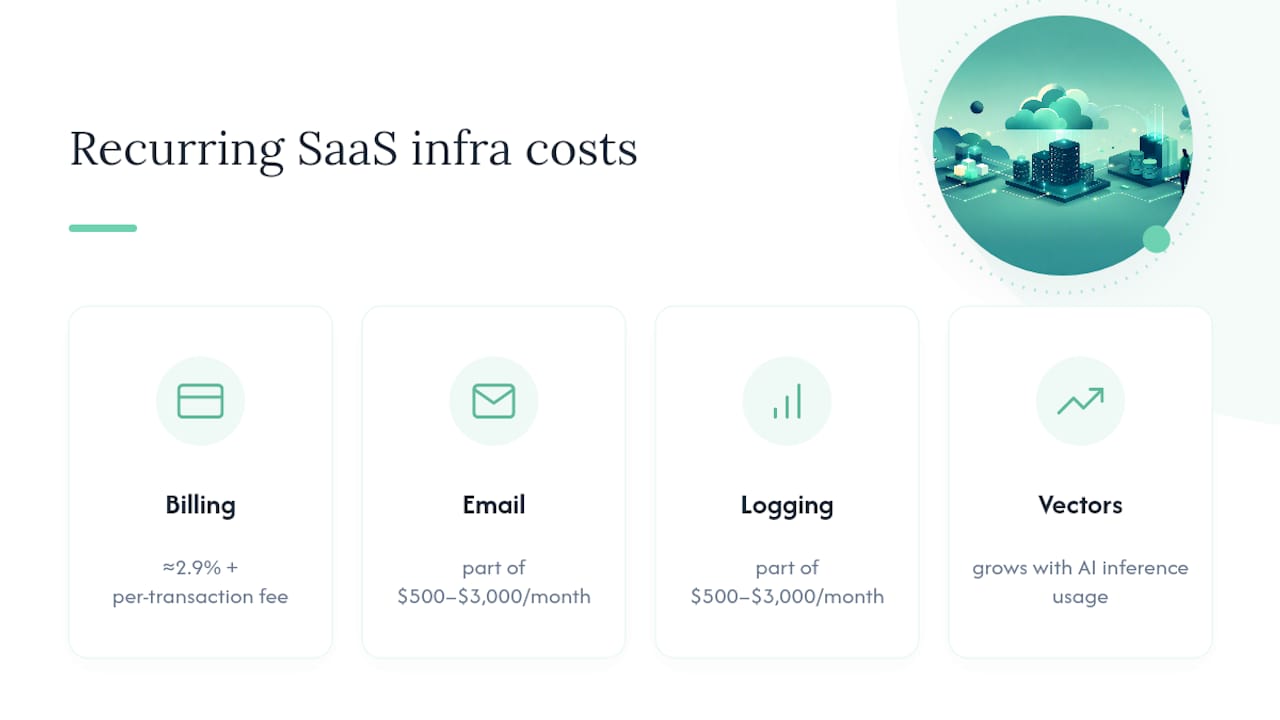
The line item that surprises founders most is AI inference. Once a product has a live user base, model API calls and vector storage costs can grow faster than revenue if nobody's watching the curve. Hidden costs across onboarding, support, and usage overages commonly push year-one actual spend 30–100% above the original list-price estimate, and AI features are frequently the biggest contributor to that gap.
Mitigation is mostly about discipline: cache repeated inference calls, set hard usage ceilings per customer tier, and review cloud spend quarterly rather than annually. A pay-on-savings review service like Cost Beacon can catch infrastructure waste that internal teams miss simply because nobody's job is to look for it.
How Should Pricing Strategy Shape Your Architecture?
Pricing isn't a marketing decision you bolt on after the product ships. It's an architecture decision, and getting the order backward is expensive.
Companies that treat pricing and packaging as something to refine regularly grow roughly 30% faster than those that set a price once and leave it alone, but that refinement only works if the underlying system can support it. Usage-based pricing requires metering infrastructure that a flat per-seat model doesn't need. Credit systems require reconciliation logic. Pro-rata upgrades and downgrades require billing code that a simple subscription toggle doesn't.
A few practical patterns worth knowing before you scope the build:
- Per-seat pricing is the cheapest to build and meter, which is why most early-stage SaaS products start there.
- Usage-based pricing (API calls, active records, AI credits) adds real engineering time for tracking, reconciliation, and overage handling, a mechanic explained in detail in Chargebee's pricing guide.
- Hybrid models (seat plus usage) offer the best long-term flexibility but cost the most to build correctly the first time.
The rule of thumb: pick the pricing model that maps cleanly to how your customers already budget, and design your upgrade triggers into the architecture before launch rather than retrofitting them after your first enterprise prospect asks for a custom plan.
What Do Real SaaS Budgets Look Like?
Three scenarios, drawn from typical project shapes, to help you place your own project on the map.
-
Scenario A: Focused MVP. Two to four months, a team of three (one senior full-stack engineer, one product designer, one QA contractor), total cost around $30,000 to $40,000. One core workflow, basic authentication, no compliance requirements, minimal third-party integrations.
-
Scenario B: Market-ready v1. Four to eight months, a team of four to six (senior engineer leading, two mid-level engineers, a designer, part-time DevOps), total cost around $70,000 to $130,000. Billing integration, proper onboarding flow, admin dashboard, and enough polish to sell to paying customers without embarrassment.
-
Scenario C: Production and enterprise-ready. Eight to fourteen months, a team of six to nine including a dedicated security or compliance lead, total cost $180,000 to $300,000+. SOC 2 Type II readiness, SSO, audit logging, multi-tenant architecture built for isolation, and often a penetration test before the first enterprise contract signs.
Costs rarely scale in a straight line between these scenarios. Two changes tend to cause sudden jumps rather than gradual increases: switching from a pooled to a siloed tenancy model mid-project, and adding a heavy third-party integration (an ERP connector, a legacy data migration) after architecture is already locked. Both are far cheaper to plan for during discovery than to retrofit during month six.
How LogicBranch Approaches Budgeting for AI-Native SaaS
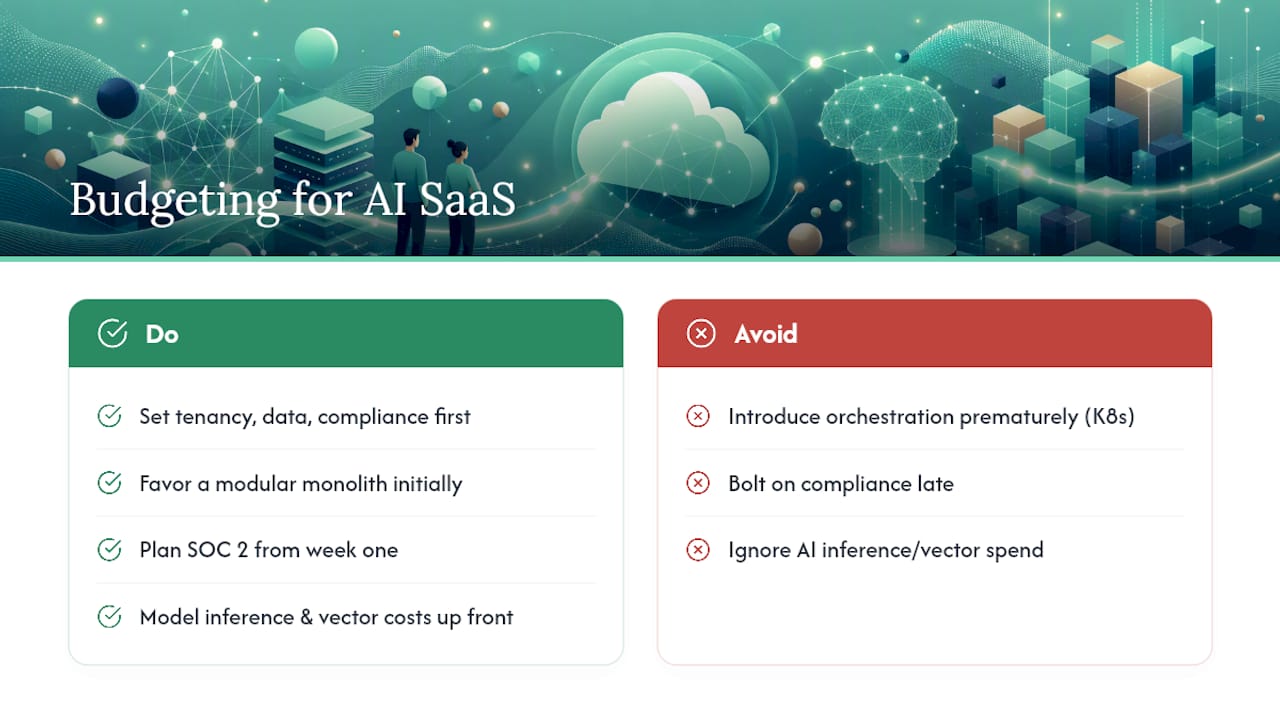
Logicbranch structures discovery around the decisions that are expensive to reverse: tenancy model, core data architecture, and compliance scope, all settled before a senior engineer writes production code. That discovery phase typically favors a modular monolith over premature orchestration complexity, deferring heavier infrastructure like Kubernetes-style orchestration until the product has validated enough scale to justify it.
For clients heading toward enterprise sales, SOC 2 readiness gets planned as a budget line from week one, not bolted on when a prospect's procurement team asks for it. And because AI features often dominate run costs in ways founders don't anticipate, Logicbranch models inference and vector-storage spend into the total cost of ownership forecast up front, not after the first surprising cloud bill arrives.
What I've Learned Building AI-Native SaaS
Paying more for a senior-led team upfront is almost always cheaper than paying less for a junior-heavy one. The rework tax is real: architectural decisions made wrong in week two of discovery don't get fixed with a quick patch, they get fixed with a rebuild, and rebuilds cost more than getting it right once.
The other lesson that keeps repeating: forecast your AI inference and compliance costs before you need them, not when the bill or the auditor shows up. Both are far more predictable than founders assume, if someone actually sits down and models them early.
— Josh
Get a SaaS Build That Skips the Rework Tax
Logicbranch is the alternative to hiring a cheaper, junior-heavy team and hoping the architecture holds. Senior-led discovery catches the tenancy, compliance, and AI-cost decisions that turn into expensive rebuilds when a less experienced team makes the call. For founders planning a build with real compliance requirements ahead, SOC 2 readiness gets mapped into the budget from the start instead of showing up as a surprise line item once an enterprise prospect asks for it.
Logicbranch builds custom AI-native SaaS platforms, from initial discovery through deployment and ongoing support, for startups and enterprises that need the architecture right the first time. If you're scoping a build and want a realistic cost estimate before you commit budget, talk to the Logicbranch team about your project.
Sources

API-First Design: What It Is and How to Apply It
API-first design means agreeing the API contract before building anything. See how it works, when it beats code-first, and how Australian businesses can use it.

Tokenization vs Encryption: How to Choose for Your Data
Tokenization and encryption protect data in different ways. Learn how each works, how they compare with masking and hashing, and which fits your Australian business.